
Artificial intelligence has permeated countless industries, bringing increased efficiency, precision, and ease of scaling. Now, AI-powered solutions like intelligent data processing and generative AI are poised to greatly disrupt the legal sector. This article explores the immense potential of these trailblazing technologies to enhance legal document processing, boost collaboration, ensure regulatory compliance, and enable organizations to thrive in today’s fast-paced digital landscape.
Understanding IDP and Generative AI
Intelligent document processing utilizes advanced AI to automatically classify, extract, and process data from legal documents with high accuracy. IDP tools can parse everything from contracts and invoices to emails and scanned files. This eliminates the need for tedious and error-prone manual data entry.
Generative AI leverages vast datasets and complex algorithms to produce written content, images, audio, code, and more. Unlike traditional AI, generative models can contextualize concepts and follow logical reasoning. State-of-the-art models like ChatGPT demonstrate strong language proficiency.
Together, IDP and generative AI form a powerful combination. IDP structurally processes documents at scale while generative models simulate human-level comprehension. This empowers the legal sector to achieve new heights in efficiency and knowledge sharing.

Delving into Kudra’s Cutting-Edge Capabilities
Purpose-built for the enterprise, Kudra is an AI platform equipped with best-in-class IDP and generative capabilities. The solution delivers precision, speed, and ease of use for streamlined legal document processing.
Kudra’s computer vision and natural language processing algorithms can extract data from diverse document types including PDFs, Word docs, CSVs, scanned images, and more with over 99% accuracy. Users praise the platform’s efficiency in parsing high volumes of contracts, legal forms, invoices, client correspondence, and other materials at remarkable speeds.
Kudra’s user-friendly interface allows anyone to build automated workflows with a simple drag-and-drop workflow designer. Over 20 pre-trained AI templates eliminate the complexity of developing document processing models from scratch. With just a few clicks, users can train custom AI models for niche use cases.
The integration of OpenAI’s GPT technology empowers users to leverage conversational AI to analyze documents, write summaries, classify content, and handle other complex legal tasks. Kudra’s reasoning engine comprehends nuances in legal language and logically breaks down unstructured data.
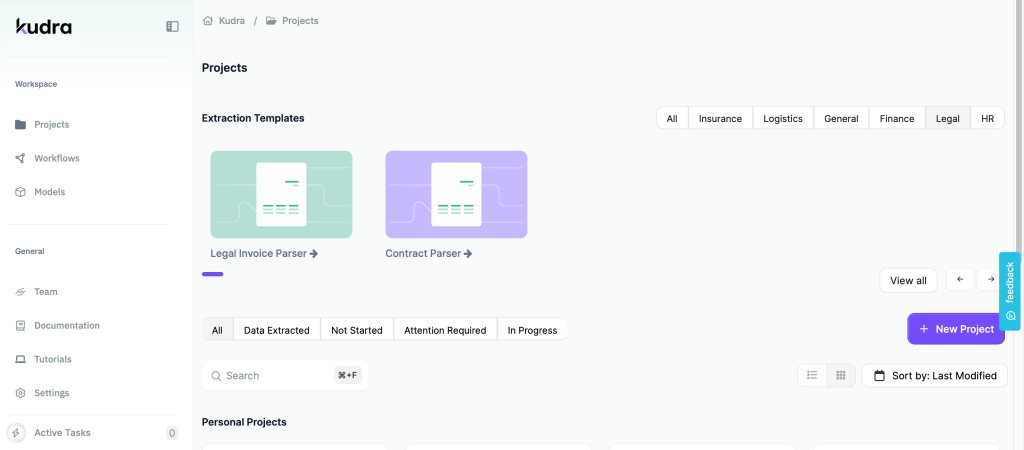
Kudra’s main dashboard
Revolutionary Use Cases in Legal
Kudra’s IDP and generative capabilities unlock game-changing applications across the legal sector:
Intelligent Document Classification
Pre-trained and custom models rapidly categorize documents by type, department, client, matter type, and other attributes, ensuring content flows to the right teams.
Information Extraction
Extract names, addresses, dates, clauses, amounts owed, and other vital details from contracts, invoices, client records, court documents, and more.
Fraud and Risk Detection
Flag suspicious patterns in contracts, fraudulent details in client documents, conflicts of interest, non-compliant clauses, and other issues.
Summarization
Automatically create concise overviews of contracts, legal briefs, client materials, and other hefty documents, improving comprehension.
Enhanced Collaboration
Share key insights extracted from documents to foster alignment across legal teams and clients. Accelerate approvals with document summaries.
Conquering Legal Sector Challenges
Intelligent document processing integrated with generative AI can help legal teams overcome several pressing challenges:
Navigating Document Complexity
Many legal documents feature dense language spanning hundreds of pages. IDP structurally processes information while generative models comprehend complex concepts. This unlocks efficiency gains.
Accelerating Due Diligence
Quickly surface risks and red flags within contracts and client documents. Generative writing streamlines the creation of summaries, memos, and other materials.
Ensuring Compliance
Continuously monitor legal documents and flag non-compliant clauses and other issues to mitigate regulatory risk. Custom AI models learn to identify niche compliance requirements.
Managing Contract Risk
Programmatically scan agreements to detect conflicts, fraud, and other threats. Generative models deliver context to assess severity, summarizing key takeaways for lawyers.
Improving Knowledge Sharing
Extract and synthesize vital information from court documents, legal briefs, client materials, and other sources into memos. Accelerate research and strategy alignment.
Adapting to Change
Rapidly train AI models to handle new document types, laws, and other changes through data augmentation and a user-friendly interface.
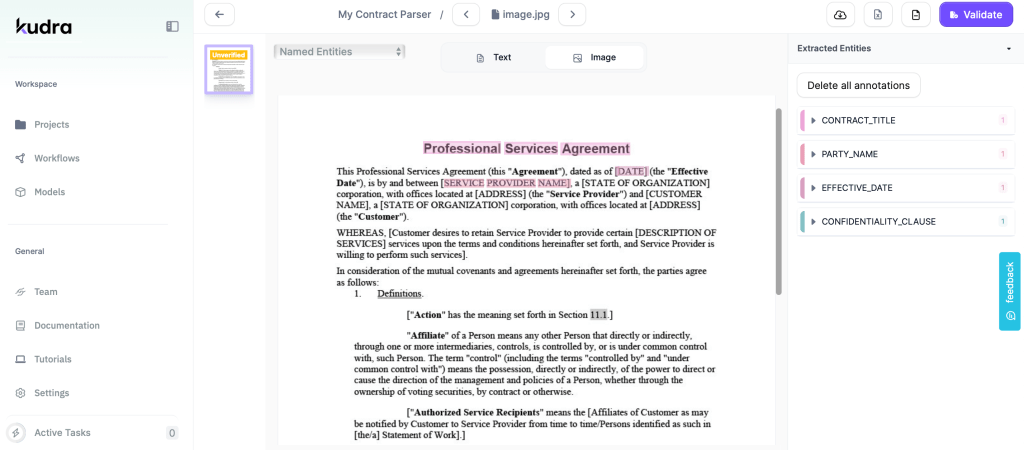
Extracting data from a contract with Kudra
The Future Is Now For Legal Document AI Processing
Intelligent document processing and generative AI will bring tremendous efficiency gains, cost savings, and risk reduction to legal teams. But more importantly, these technologies will enable genuine transformation:
With key information programmatically extracted from documents, lawyers can devote more time to high-value work like litigation strategy and client counsel. Technical bottlenecks will dissolve.
Document insights can be rapidly synthesized and shared across legal teams, clients, court systems, and other stakeholders to improve alignment.
As models continuously learn, legal organizations will constantly stay ahead of new laws, compliance demands, fraud tactics, and other emerging challenges.
The time for legal organizations to embrace AI-powered document processing is now. With solutions like Kudra, they can be propelled into the future – where efficiency, collaboration, and knowledge-sharing reign supreme. The legal landscape will never be the same.


