
It’s 2024, yet businesses worldwide still rely on antiquated, manual processes for critical document processing tasks. Teams waste countless hours extracting data from contracts, invoices, and more. As volumes swell, existing systems buckle under the weight of unstructured data.
Accuracy suffers. Efficiency plunges. Costs skyrocket. Businesses require an intelligent solution to lift this monumental burden.
Legal Document Management Challenges
The Problem: Manual Document Processing in the Legal Sector
For decades, crucial functions in the legal sector have relied on manual document processing. Legal professionals expend valuable time extracting relevant data points from contracts, court filings, motions, and other unstructured documents.
As the volume of documents grows, existing manual processes become woefully inadequate, creating bottlenecks that impair overall efficiency within legal practices.
Common issues include:
– Data Entry Errors: Manual data entry inevitably leads to mistakes, regardless of how careful employees are. Typos and incorrect information reduce data accuracy.
– Delayed Operations: With manual processing, documents sit idle waiting for an available employee. This slows down operations while data extraction lags behind.
– Limited Visibility: Until documents are processed, stakeholders lack visibility into key data such as contract clauses, case details, and filing statuses.
– Wasted Time: Legal professionals spend hours performing repetitive, low-value tasks like data entry, underutilizing their specialized skills.
Manual processes fail to scale. Expanding document volumes overwhelm employees, creating bottlenecks across the legal practice. Data accuracy suffers, efficiency plunges, and costs skyrocket.
The legal sector requires an intelligent solution capable of rapid, accurate document processing at scale.

The Solution: AI-Powered Legal Document Management Platform
Overcoming Manual Document Processing in the Legal Sector with AI
To overcome the monumental burden of manual document processing, leading legal practices are now leveraging artificial intelligence. AI empowers law firms to extract accurate data from documents in seconds, eliminating repetitive manual effort; it is Transforming Document Processing in the Legal Industry !
Introducing Kudra – the AI-Powered Legal Document Management Platform built for the modern legal practice.
Purpose-built for the legal sector, Kudra uses advanced AI to extract accurate data from contracts, court filings, motions, and more. Utilizing computer vision and natural language processing, Kudra reads, comprehends, and processes documents just like a human.
Kudra’s key capabilities include:
– Intelligent OCR: Advanced optical character recognition (OCR) interprets scanned documents, images, handwriting, and other hard-to-parse data.
– Data Extraction: User-friendly workflows extract and structure key data points from unstructured legal documents.
– Custom AI Models: With just a few labeled examples, non-technical users can train custom AI models to handle unique legal document types.
– Seamless Integrations: Extracted data can be sent to legal management systems, databases, and cloud storage platforms.
With Kudra, legal practices can analyze thousands of documents daily, funneling structured data into downstream systems without manual effort. Kudra frees legal professionals from repetitive tasks, allowing them to focus on high-value initiatives. So What Are the Advantages of Legal Document Software?
Let’s explore Kudra’s transformative capabilities for the legal sector.
Automating Legal sector with Kudra
Kudra’s Capabilities for Legal Document Management
For legal document reconciliation, Kudra offers the following capabilities:
Automated Classification
Kudra can instantly classify legal documents and extract key metadata such as:
– Document Type
– Case numbers
– Filing dates
– Parties involved
This structured information sets the stage for smooth reconciliation.
AI-Powered Data Extraction
At the heart of reconciliation is matching every single data point between the imported legal documents and case records.
Kudra’s AI OCR engine can scan and interpret text, numbers, and symbols from tables and descriptions across every document line.
The platform extracts rich details, including:
– Dates
– Amounts (for financial documents)
– Names of involved parties
– Locations
– Descriptions of legal actions
Meanwhile, Kudra’s NLP algorithms contextualize the text, resolving ambiguities. This enables matching against entries in the case management system.
Data Matching & Exceptions Flagging
Kudra compares the extracted data from legal documents against entries logged in the case management system.
Its AI assistants can model complex postings across systems and match data with a high degree of accuracy.
The platform flags any document lines that don’t have a corresponding entry in the case management system for further review.
Kudra assigns “probability scores” to its data matches and exceptions, allowing reviewers to prioritize investigating anomalies over likely accurate matches.
Reconciliation Reporting
Finally, Kudra generates a reconciliation report detailing:
– All matched data points
– Any exceptions flagged
– Case progress
– Total documents reconciled
This empowers legal professionals to instantly view discrepancies between legal documents and case records at a glance.
The Incredible Speed, Precision and Ease of Kudra
Purpose-Built for Legal Practices, Kudra Combines Speed, Accuracy, and Ease of Use
Kudra is designed specifically for legal practices, offering blazing speed, pinpoint accuracy, and ease of use. With Kudra, law firms can process thousands of legal documents daily and integrate data across their case management systems.
Unmatched Speed
Kudra leverages AI to rapidly process legal documents that would overwhelm human capabilities.
Fast Response Time: Kudra’s AI extracts data within seconds.
High Volume Processing: Kudra effortlessly handles thousands of legal documents per hour without slowing down.
Low Latency: With on-demand scalability, Kudra maintains speed regardless of processing volumes.
Kudra’s speed accelerates document processing from days or weeks to mere hours, even for backlogs numbering in the tens of thousands.
Effortless Workflows
Kudra makes AI-powered document processing accessible to non-technical users through an intuitive, no-code platform.
Easy Data Labeling: Users label examples to train AI models or build workflows specific to legal documents.
Visual Workflow Builder: Construct document analysis workflows with simple drag-and-drop interfaces.
AI Assistants: Utilize AI for tasks like contract summary, legal document classification, and data validation.
Pre-Built AI Templates: Launch common workflows for analyzing contracts, court filings, and motions with one click.
With Kudra, legal professionals can build automated document analysis solutions without coding, allowing them to extract and deliver data wherever it’s needed. This enables law firms to streamline their operations, reduce manual effort, and focus on high-value legal work.
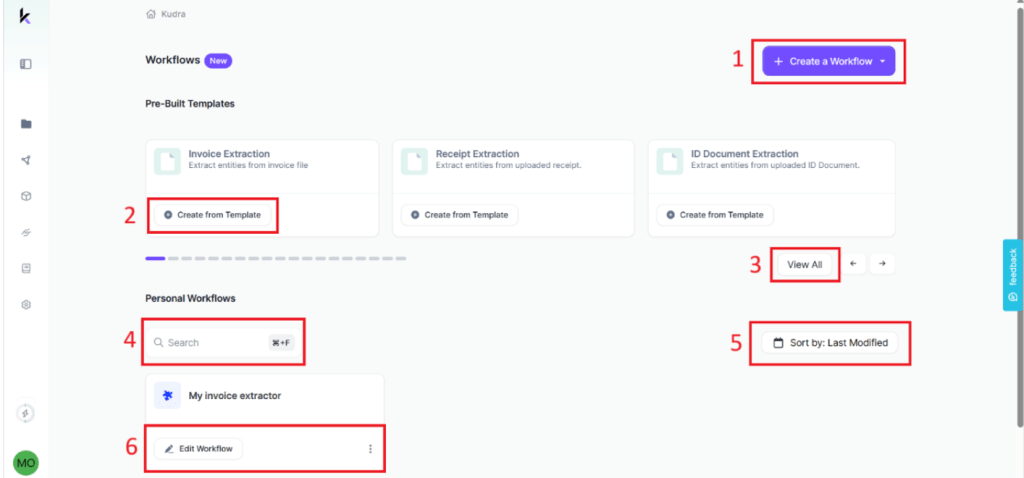
1- Main workflows page
1. The create workflow can be used to create a workflow from scratch or from an existing template.
2. The “Create from template” is a shortcut to create a workflow from the associated template and move to the workflow edit screen where you can apply further modification before saving the created workflow.
3. The “View All” button displays the list of all available templates for workflow creation.
4. The search bar searches your custom workflows.
5. Display filters for your custom workflows.
6. For each personal workflow, you have the option to edit, delete or duplicate.
Practical Applications in the Legal Sector
While Kudra provides pre-built AI solutions for handling common document types like contracts, each legal practice has its own distinct needs. Kudra enables users to train custom machine learning models to extract data from specialized documents that generic, out-of-the-box tools may struggle with.
With just 20 hand-labeled examples, Kudra can create highly accurate AI models tailored to a firm’s specific documents and data requirements. This training data helps the model understand variations in layout, terminology, data fields, and other attributes across a document corpus.
Lawyers can leverage custom models to unlock a wealth of actionable information from critical legal documents such as:
– Transactional records: Identify parties, dates, amounts, and other key details.
– Motions: Flag relevant citations, rulings, judges’ names, and legal factors.
– Patent filings: Extract inventor names, patent types, technology categories, and more.
– Police reports: Pull out incident descriptions, involved parties, dates, and other specifics to expedite case preparation.
– Witness statements: Uncover dates, sequences of events, individuals mentioned, and other facts.
– Exhibits: Retrieve filing dates, parties’ names, and other metadata.
The possibilities are endless. Custom models make even the most complex document-based legal workflows significantly more efficient. For instance, a model can be trained to review contracts and identify specific termination clauses, allowing lawyers to assess and act on cancellation risks more quickly.
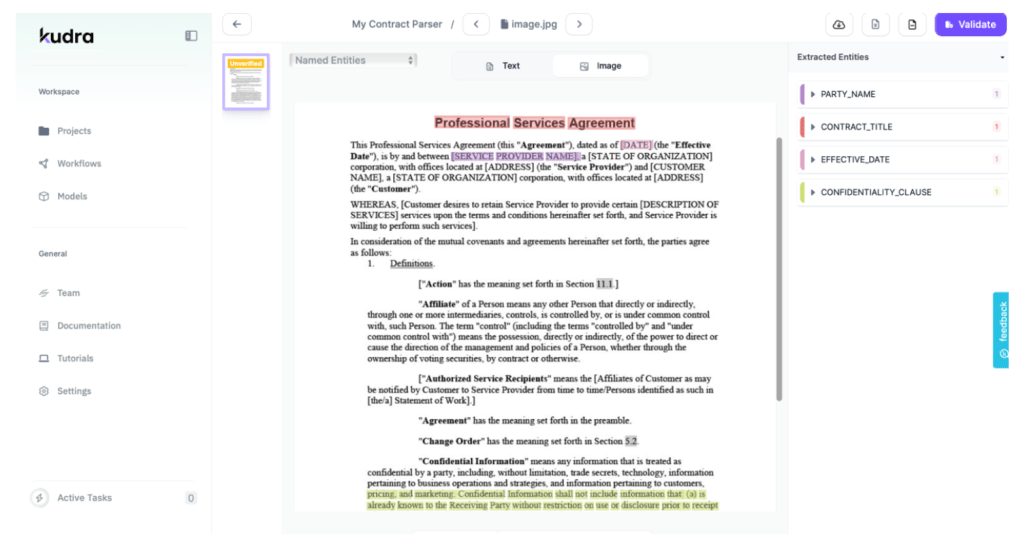
Data extraction from a contract with Kudra
The Future of Legal Document Management ?
Kudra ushers in a new era for legal firms burdened by manual document processing. AI eradicates bottlenecks caused by unstructured data while illuminating critical information flows.
With a blend of rapid processing, precise extraction, and user-friendly interfaces, Kudra empowers legal practices to leverage documents as catalysts for efficiency rather than hurdles. Data transforms into a competitive advantage rather than a liability.
As AI capabilities become more sophisticated and accessible, virtually no document processing task remains beyond automation’s grasp. The question shifts from if to how swiftly AI can revolutionize your firm’s workflows.
Why not discover Kudra’s transformative potential today? Our AI experts stand ready to tailor state-of-the-art document analysis solutions to your most pressing legal needs. The future of intelligent document processing is within reach.


