
Staying on top of logistics documents is no easy feat. Shipping manifests, intricate bills of lading, and detailed logistics reports inundate operations teams daily. Making sense of these complex documents to extract essential data is tedious and time-consuming, hampering efficiency.
This is where Kudra comes in. Kudra is an innovative AI platform built to analyze and extract data from unstructured documents, including the myriad forms logistics teams handle. Its advanced optical character recognition, intelligent workflows, and integration capabilities provide precise, automated document processing.
In this post, we’ll explore the difficulties of managing logistics documents, see how Kudra’s AI simplifies these processes, examine its data extraction capabilities, and discuss how you can train custom AI models. Read on to learn how Kudra can enhance your document handling and unlock supply chain insights.
The Pains of Logistics Document Management
Logistics teams deal with various document types, each presenting distinct data extraction challenges. Let’s examine some common issues:
Shipping Manifests
These list contents and transport details for shipments. Manifests can run over 50 pages, mixing tables, diagrams, and paragraphs across multiple file types. Just identifying critical shipment data is hugely time-consuming.
Bills of Lading
These contracts between shippers and carriers contain key transport terms, costs, and inventory specifics. However, details are buried among dense legal jargon spanning printed scans, PDFs, and even faxed copies. Interpreting these documents hampers responding to disputes, audits, and client queries.
Logistics Reports
Detailed reports track cargo flows, costs, and performance. They combine figures, charts, and analysis, making aggregating vital metrics like cycle times, budget overruns, and bottlenecks extremely difficult.
Manually processing these documents is inefficient, delaying responses and decisions. It also heightens risks of data entry errors that compound across supply chain systems. Automating this documentation could unlock huge time and cost savings.
But How to Automate your Supply Chain Data Processing? This is where Kudra comes in.

Kudra: AI-Powered Document Processing for invoice Data Extraction
Kudra provides Intelligent Document Extraction for Logistics and Supply Chain using advanced AI algorithms. Its automated data extraction capabilities help simplify supply chain document handling.
Specifically, Kudra can:
– Parse any document type and extract information
– Build custom workflows to analyze unstructured data
– Enhance processing with NLP capabilities from ChatGPT
– Access pre-trained AI templates for common use cases
– Create custom AI models for unique data extraction needs
With Kudra, supply chain teams can speed up documentation processes and access actionable data faster. Let’s examine its capabilities in more detail.
Simplifying Logistics Documents with Workflows
Kudra makes it easy to set up workflows to process diverse logistics documents and extract information. Its user-friendly interface lets you integrate various data extraction tools:
- Optical Character Recognition (OCR)
Kudra supports advanced OCR techniques like layout analysis to identify text, tables, diagrams, and more across scanned paper documents, PDFs, and images. This works across over 180 languages.
You can even tune OCR accuracy for tricky documents using pre-processing tools like deskew, binarization, and denoising.
- Data Extraction
Define rules to pick out relevant text, numbers, dates, names, codes or patterns. Extract data into neat tables ready for analysis and integration.
- Validation Checks
Set up rules to catch irrelevant or incorrect data. This helps enhance extraction accuracy for downstream systems.
- File Conversion
Standardize file formats or split documents like multi-page PDFs into single pages for simpler processing.
- Post-Processing
Automatically route extracted data to required systems via API, email, cloud storage, or even robotic process automation bots. No more manual re-entry!
This is just a sample of Kudra’s broad capabilities. With its flexible no-code interface, you can analyze logistics documents like shipping manifests, waybills, and cargo reports to extract shipment details, costs, locations, performance metrics, and more.
Let’s walk through an example shipping manifest workflow:
The workflow would first deskew and OCR complex, multi-page manifest PDFs spanning forms, tables, paragraphs, and diagrams.
Next, it would extract critical details like container numbers, weights, product codes, destinations, dates, and transport references using regular expressions, keywords, and data validation rules tuned over time.
Finally, extracted data gets routed to TMS and ERP systems via API for real-time shipment tracking, billing, and inventory updates.
With workflows like this, Kudra can simplify supply chain document handling to unlock massive time savings and data accuracy.
Enhancing Workflows with ChatGPT
Kudra also uniquely integrates powerful NLP capabilities leveraging the ChatGPT engine. The ChatGPT module adds a reasoning layer to workflows for incredibly flexible document analysis.
You can leverage ChatGPT for use cases like:
– Classifying logistics documents like identifying shipment notices vs invoices.
– Reviewing legal terminology in supply contracts.
– Summarizing key details from lengthy logistics reports.
– Comparing invoice amounts to bank transfers to catch duplicates.
– Assessing storage compliance rules across facilities.
– Checking cargo handling guidelines by port.
The possibilities are endless. For ad hoc needs, just send document excerpts or paragraphs to ChatGPT to generate summaries, translate jargon, identify entities, check calculations, and more.
The ChatGPT integration supercharges Kudra’s capabilities, helping automate even subjective document analysis.
AI Templates for Common Use Cases
Kudra offers an expanding library of over 20 pre-trained AI templates covering common document processing needs. Logistics teams can benefit from:
- Bill of Lading Data Extraction
Instantly pull out shipment details, destinations, cargo types, quantities, and transport references from bills of lading.

Extracting data from BOL
- Commercial Invoice Parsing
Quickly validate amounts, part codes, and supplier details against invoices in any format or layout.
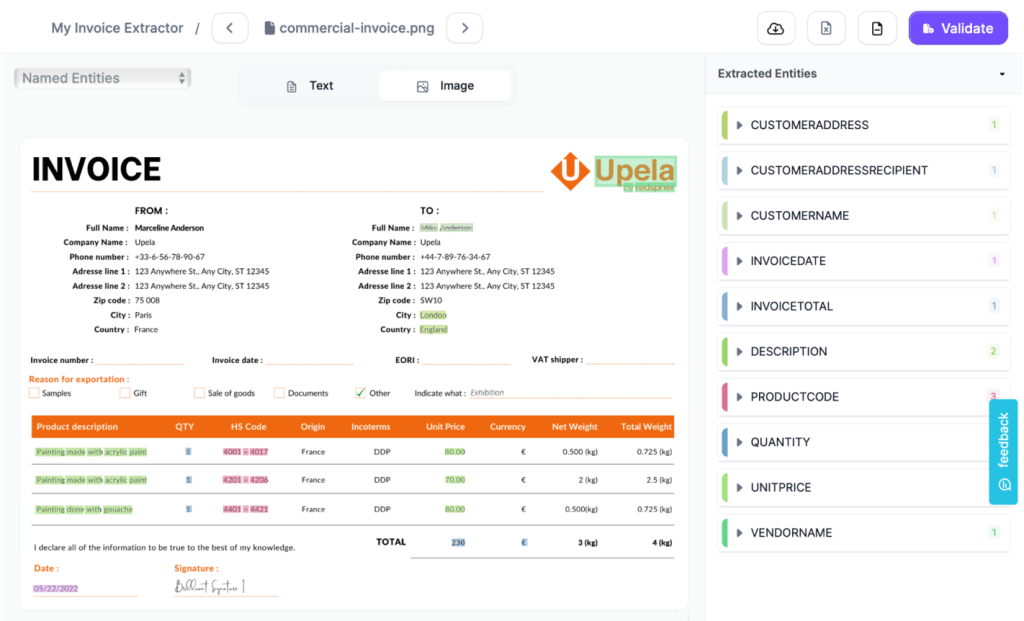
Extracting data from Invocies
- Route Sheet Extraction
Easily track delivery sequences, cargo allocations, and expected arrival times across the fleet.
These are just a few templates available. With ready-to-use workflows for oft-handled documents, it’s easy to jumpstart automation in your business. Kudra also lets you tune these templates to perfectly fit your unique documents.
- Building Custom AI Models
Kudra also allows creating custom AI models tailored to your specific data extraction needs.
While out-of-the-box workflows handle many common documents, some complex use cases require specialization. Contracts, custom forms, legacy systems, and niche document types often need a custom approach.
Kudra lets you train AI models with just a sample of labeled documents – no coding or data science expertise required! The interface guides you to:
- Upload a set of ~15 example documents
- Label the data points you want to extract
- Initiate model training
In just hours, Kudra will generate a tuned AI model that learns the structure, language, and terminology of your custom documents. This model will deliver extraction accuracy exceeding 85-90% in most cases – far beyond generic algorithms.
As an example, a 3PL could train a model to parse transport safety certifications spanning policies, inspection sheets, and audits. It would accurately extract renewal dates, authorized cargo types, storage guidelines, and corrective actions recommended across a variety of formats.
Such specialization unlocks the ability to automate unique business documents at scale.
Summary
Logistics documents like shipping manifests, waybills, and cargo reports provide a wealth of transport data. However, current manual processes hamper extracting value from these documents. Multiple formats, layouts, and file types create complexity.
Kudra provides advanced AI-based document processing to simplify and automate such unstructured data. Customizable workflows, NLP integration with ChatGPT, out-of-the-box templates, and custom model training provide flexibility to handle diverse needs.
With Kudra, supply chain organizations can speed up documentation processes, enhance data accuracy, and unlock deeper visibility across the logistics value chain. The efficiency gains and informed decisions ultimately translate to improved customer service, cost savings, and competitive advantage.
It’s time to leverage AI and simplify the complexity of business documents. Schedule a demo today to see Kudra in action!


