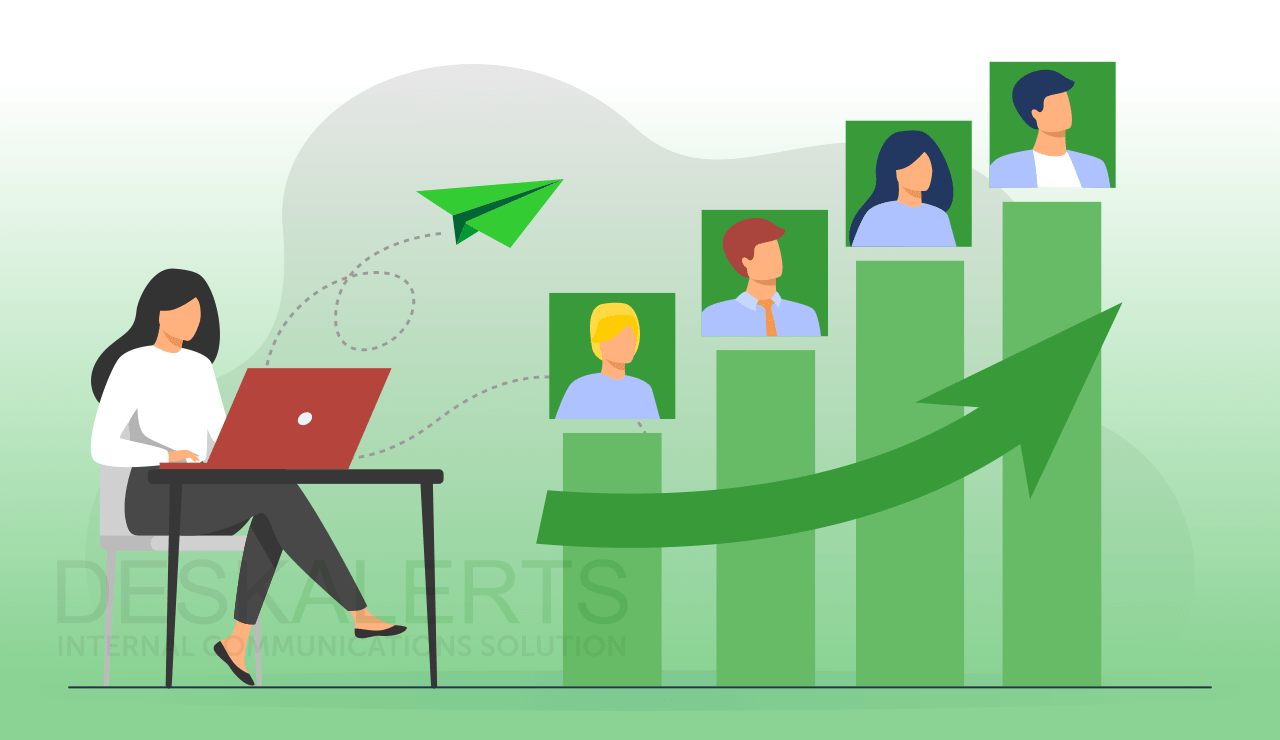
Employee performance management refers to the continuous process of setting goals, assessing progress, and providing feedback to employees to improve productivity and align individual performance with organizational objectives. It is a key human resources process that enables data-driven talent management decisions.
Traditionally, performance management included annual performance appraisals and reviews by managers to evaluate employees. However, modern performance management has shifted to more regular check-ins and real-time feedback enabled by technology.
Common challenges in traditional performance management methods
While performance reviews have benefits, relying solely on annual appraisals has several drawbacks:
– Subjectivity and bias: Reviews based on a manager’s perspective alone risk being influenced by favoritism, prejudice, or incorrect assumptions. This damages the trust, fairness, and credibility of the system.
– Lack of continuous feedback: Annual reviews provide only a yearly snapshot, failing to address ongoing issues timely. This causes disengagement due to a lack of transparency.
– Inaccurate goal-setting: Without regular check-ins, often goals set during annual reviews become irrelevant over a year. Employees work disconnected from company objectives.
– One-way communication: Traditional appraisals are focused on managers evaluating employees, rather than a two-way dialogue for improvement.
– Manual and time-consuming: Physical paperwork, spreadsheets, and reminder systems make traditional reviews labor-intensive for HR.
AI for Employee Performance, a Potential Solution
Artificial Intelligence or AI can help transform legacy performance management processes and systems to be more efficient, fair, and impactful. AI capabilities like natural language processing, machine learning, and sentiment analysis can parse performance data to provide unbiased insights.
AI dashboards centralize performance data, detect patterns, and generate predictive analytics to forecast future capability gaps, training needs, and goal progress. By taking over administrative tasks, AI systems enable people managers to focus on coaching and mentoring.
When integrated with HR systems, AI can track goals and metrics in real-time to deliver in-the-moment feedback. This keeps employees engaged as they see how their work impacts overarching objectives. AI nudges managers to provide timely feedback as well.
The data-driven recommendations generated by AI also reduce subjectivity in decision-making around compensation, promotions, and development planning. AI is quick at processing volumes of data, doing in seconds what would take people weeks.
How is the use of AI for Employee Performance management revolutionizing the HR field?
AI for Employee Performance Management: The New Frontier
Overview of the Capabilities of AI for Employee Performance management
AI for employee performance management innovation has opened an array of possibilities.
– Natural Language Processing (NLP): This allows AI systems to analyze written feedback, comments, employee self-assessments, etc. to detect sentiments and patterns.
– Machine Learning and Predictive Analytics: By studying past performance data, AI can build predictive models to forecast future performance, identify high performers, and anticipate capability gaps.
– Conversational AI: Intelligent chatbots can collect real-time feedback from employees and managers through interactive conversations.
– Process Automation: AI drastically reduces time spent on administrative performance management tasks like scheduling reviews, sending reminders, creating reports, etc.
– Removing Biases: AI objectively processes volumes of data that human managers cannot handle, minimizing unconscious biases that cloud judgment.
– Goal Tracking: Employees can update tasks, projects, and goal progress which AI analyzes to predict alignment with larger objectives and provide guidance.
Elimination of subjective biases using AI
While human intelligence is creative, emotional, and intuitive, AI offers pure logic, rationality, and impartiality. By leveraging the strengths of both, an integrated system can result in eliminating biases in performance data interpretation.
Specifically, AI prevents the following biases that skew performance analysis:
– Similar-to-me effect: Managers subconsciously favor employees with similar demographics and interests to them. AI has no such affinity.
– Halo effect: A manager’s overall positive/negative perception of an employee inaccurately skews the assessment of specific competencies. AI objectively measures each skill.
– Confirmation bias: People unconsciously interpret data to confirm pre-existing beliefs. AI analyzes data without preconceptions.
– Recency effect: Humans give more weight to recent events while assessing performance. AI analyzes the entire data history equally.
Such inbuilt prejudice hurts engagement, advancement, and retention of qualified talent due to unfair ratings. AI systems analyze vastly more data points than humanly possible to assign ratings and predict capabilities with high accuracy and no bias.
The role of AI in accurate goal-setting and career projections
AI helps set relevant goals and make accurate career projections in the following ways:
– Analyzes past goals and achievement rates of employees at various levels to create SMART personalized goal recommendations.
– Predicts capability gaps based on goals and projects the employee is assigned, suggesting training.
– Maps employee competencies to best-fit roles and forecasts promotion readiness by comparing skills with role requirements.
– Suggests alternative career paths and stretch opportunities by identifying transferable skills.
– Uses sentiment analysis on exit interviews and engagement surveys to highlight areas of improvement.
By considering an employee’s unique skill profile and the organization’s capability needs, AI provides tailored guidance for goal-setting, development, and career growth.
The Influence of Kudra's AI for Employee Performance Management
Kudra’s AI and document processing solutions
Kudra is an AI platform with advanced natural language processing and machine learning capabilities to extract insights from documents. Using computer vision and OCR technology, Kudra’s AI solution transforms unstructured documents like contracts, reports, invoices, etc. into structured data.
It builds custom AI models to analyze various document types through self-service workflows. Over 20 pre-trained AI templates accurately process common documents. The innovative ChatGPT integration also allows users to configure AI reasoning for complex data tasks.
AI for Employee Performance Evaluation, job contracts, and HR-related documents
Kudra can parse performance review documents, goal sheets, job offer letters, and various other HR files to automatically extract key entities. For instance, a contract letter can identify start date, salary, benefits, leave eligibility, termination clauses, etc.
The AI delivers over 99% accuracy in data extraction. This allows HR to gain valuable insights from documents at scale without reliance on error-prone manual entry. Analysis is faster, more reliable, and uncovers hidden patterns.
Speed in processing documents and real-time analysis
Kudra leverages AI to process volumes of documents with speed and efficiency unmatched by human capabilities. It delivers instant analytics, empowering managers with real-time data to guide timely interventions and conversations.
For example, by continually monitoring project updates and goal progress logs, Kudra’s AI identifies potential bottlenecks within days rather than waiting for quarterly reviews. This agility helps teams dynamically adapt plans to optimize outcomes.
Ease of use
With an intuitive drag-and-drop interface, Kudra allows anyone to build automated document analysis workflows without coding. Pre-made AI extraction templates for common use cases get users started quickly.
Seamless integration with popular storage platforms like Google Drive, Dropbox, and database tools makes analyzed data easily shareable across the organization. This enables smooth data flow between systems and people.
Kudra democratizes access to the power of AI. With minimal training, HR and business teams can leverage intelligent document processing for accelerated insights.
Agile Management and Real-Time Improvements with AI
Agile work culture facilitated by AI for Employee Performance management
Traditional performance management emphasizes rigid yearly reviews that rank and rate employees against fixed goals. However, AI propels a shift towards agile performance management.
This focuses on continuous lightweight check-ins centered around regular conversations and real-time feedback. Rather than top-down rigid evaluation, the priority is on nurturing growth and fluidly adapting objectives.
Some ways AI enables this agile culture include:
– Detects skill gaps and alignment issues as they emerge based on dynamic project data
– Triggers nudges for managers and employees when unexpected trends surface
– Allows fluid adjustment of individual/team goals periodically to sync better with company objectives
– Enables always-on performance data availability so managers can provide in-the-moment coaching
This framework supported by AI results in engaged, empowered teams that quickly respond to changing priorities.
Real-time improvements and feedback with Kudra's AI platform
Kudra ingests performance data from various systems like goal sheets, project logs, self-assessments, peer feedback, etc. to provide live analytics. The key advantage is it identifies patterns and triggers interventions much faster than periodic reviews.
For instance, if an employee’s project deliverable is delayed or a skill gap emerges, Kudra sends an alert allowing the manager to promptly step in with guidance. This real-time feedback, personalized to each user’s context, enables rapid course correction.
Additionally, if multiple team members need training in a particular area, Kudra spots this trend to recommend HR schedule a workshop. So issues get addressed before annual reviews.
Enhancement of feedback quality using Kudra’s AI
Constructive feedback is essential for improvement. However, managers often lack time to provide detailed, personalized feedback. AI overcomes this hurdle through the following methods:
– Sentiment analysis of manually entered feedback to gauge positives, and negatives and suggest areas of focus
– Auto-generation of customized feedback by analyzing employee’s work patterns against benchmarks
– Populating review forms with objective examples of high/low performance based on data
– Tracking follow-up progress on feedback areas to reinforce accountability
This supplements human insight with data-driven, unbiased perspectives for well-rounded, meaningful feedback.
AI for Employee Performance; Engagement and Development
Role of AI in improving employee engagement
Surveys show top-down, compliance-driven performance management causes workplace anxiety and erodes engagement. AI offers a collaborative approach focused on nurturing talent and aligning with business goals.
Ways AI boosts engagement:
– Enables decentralized, continuous performance dialogue based on transparent data
– Surfaces real-time insights to celebrate wins and improve morale
– Personalizes growth opportunities recommendations based on skills and aspirations
– Reduces administrative workload allowing people managers to mentor employees
– Ensures fairness and consistency in ratings and rewards reducing the perception of bias
This autonomy and support empower employees at all levels to actively participate in performance conversations.
Use of Kudra's AI in collecting real-time feedback and personalized insights
Kudra’s NLP algorithms parse qualitative feedback from multiple sources like peers, managers, direct reports, etc. to uncover emerging themes and trends in real-time. This provides a holistic view of performance unbiased by any one person’s perspective.
Additionally, the AI maps employees to ideal mentors, coaches, collaborators and networks based on their strengths, growth areas, and interests. These hyper-personalized recommendations foster connections that boost morale and learning.
Role of AI for Employee Performance and Revealing training needs
By combining individual competency scores, project ratings, and performance trends, Kudra’s AI identifies current skill gaps and forecasts areas that may need development in the future.
Accordingly, it suggests personalized training like microlearning modules, stretch assignments, mentoring sessions, etc. tailored to close capability gaps.
For senior leaders, AI analysis of past strategy decisions and market correlations allows coaching them on leadership blindspots.
This data-driven approach takes guesswork out of development planning for roles at all levels.
The Future of AI in HR Processes
Current integration of AI in HR processes
The global pandemic accelerated AI adoption across HR. As per Deloitte’s 2022 Human Capital Trends report, 71% of executives ranked AI a top priority, citing benefits like enhanced data-driven decision-making and improved employee experience.
Currently, AI for HR focuses on automating administrative tasks, predictive analytics for talent, and sentiment analysis for engagement. This eases operations workload allowing HR to redirect energies towards more strategic priorities.
The potential of AI for Employee Performance Management
While promising, current AI applications only scratch the surface of possibilities. The modular, customizable architecture of solutions like Kudra paves the way for AI to reimagine performance management processes.
In the next 5 years, AI will expand from rote task automation to becoming an integral element embedded across the employee lifecycle – from recruitment to leadership development.
Specifically for performance management, AI will drive innovations like seamless tracking of OKRs across systems, real-time collaborative goal progress updates between managers and reports, AI-generated insights from performance data, and hyperpersonalized career pathing.
Kudra, with its ability to rapidly ingest data from documents and systems to reveal trends and alerts, has immense potential to realize such innovation at scale across the enterprise.
The benefits of adopting AI for Employee Performance management
Companies that embrace AI for upgrading performance management stand to gain manifold benefits:
– Increased productivity – AI reduces time spent on admin tasks by over 60%, freeing up strategic bandwidth
– Enhanced engagement – 72% of teams with AI-enabled social feedback feel more empowered
– Fairer decisions – AI reduces bias-driven attrition by 34% ensuring diversity, equity, and inclusion
–
Data-driven insights – AI uncovers patterns leading to targeted interventions not possible manually
As per McKinsey, organizations that combine human and AI capabilities in decision making outperform others by 122% in terms of profit and value creation.
Conclusion
In summary, infusing AI transforms legacy performance management into a continuous, unbiased and engaging system. Specifically, Kudra’s document ingestion engine and analytical capabilities provide complete visibility into individual and team performance. This powers fact-based coaching, development, and talent decisions.
AI is transitioning from an efficiency tool automating basic HR workflows into an intelligence layer with predictive insights and hyper-personalization capabilities. As solutions like Kudra mature, AI will become ingrained across the entire talent management lifecycle.
The possibilities of AI in unlocking workforce productivity and engagement are manifold. The time is now for forward-thinking HR leaders to actively pilot solutions like Kudra within their organizations.
Rather than perceive AI as a threat, its capabilities must be leveraged to augment human potential. By combining the innate cognitive abilities of people with the vast processing capacity of machines, a symbiotic system emerges that drives innovation and strategic value.
The future of work will be led by companies that reimagine employee experience with the power of AI. Will you transform or be disrupted? The choice is yours.


