
Transforming Financial Report Analysis with AI-Driven Extraction
In today’s fast-paced business environment, the ability to quickly and accurately analyze financial reports is crucial for making informed decisions. However, the sheer volume of data contained in these reports can be overwhelming, often leading to inefficiencies and potential oversights. Enter Kudra, an innovative AI-powered platform designed to revolutionize the way we approach financial report analysis. In this comprehensive blog post, we’ll explore how Kudra is transforming the landscape of financial data extraction and analysis, offering a solution that combines precision, speed, and ease of use.
Picture this: You’re a financial analyst tasked with reviewing quarterly reports from dozens of companies in your portfolio. Each report is hundreds of pages long, filled with tables, charts, and dense paragraphs of text. Your job is to extract key financial metrics, identify trends, and provide insights to guide investment decisions. Traditionally, this process would involve hours of manual data entry, cross-referencing, and analysis – a time-consuming and error-prone endeavor.
This scenario is all too familiar for professionals in finance, accounting, and related fields. The exponential growth of data in recent years has only exacerbated the challenge. According to a report by IDC, the volume of data created, captured, copied, and consumed worldwide is projected to grow to 175 zettabytes by 2025. In the realm of financial reporting, this translates to an ever-increasing mountain of documents that need to be processed and analyzed.
The need for a more efficient, accurate, and scalable solution is clear. This is where Kudra steps in, offering a powerful AI-driven approach to document processing and analysis.
The Purpose: Simplifying Financial Data Analysis with AI
Kudra is not just another document processing tool; it’s a comprehensive AI platform designed to transform the way we interact with unstructured data. At its core, Kudra aims to simplify the complex task of extracting, analyzing, and interpreting data from various types of financial documents.
The primary purpose of Kudra in the context of financial report analysis is threefold:
1. Automation of Data Extraction: Kudra leverages advanced AI and machine learning algorithms to automatically extract relevant data from financial reports, regardless of their format or structure.
2. Standardization and Normalization: Once extracted, Kudra standardizes the data, ensuring consistency across different reports and time periods. This step is crucial for meaningful analysis and comparison.
3. Intelligent Interpretation: Going beyond mere extraction, Kudra employs generative AI capabilities to provide insights, summaries, and even predictive analysis based on the extracted data.
By addressing these key aspects, Kudra aims to dramatically reduce the time and effort required for financial report analysis while simultaneously improving accuracy and depth of insights.
You can watch the recording of our Webinar :
Key Features of Kudra: Where AI Meets Financial Reporting
To truly appreciate the transformative potential of Kudra, let’s delve into its key features and how they specifically apply to financial report analysis.
Key Features of Kudra: Where AI Meets Financial Reporting
1. Data Extraction
1.1. Advanced OCR Capabilities:
At the heart of Kudra’s data extraction prowess is its sophisticated Optical Character Recognition (OCR) technology. This isn’t your run-of-the-mill OCR; Kudra’s system is designed to handle a wide variety of document types with high accuracy.
– Multi-Format Support: Whether you’re dealing with PDFs, scanned images, Word documents, or even handwritten notes, Kudra’s OCR can handle it. This is particularly useful in financial analysis, where reports may come in various formats depending on the source.
– Table and Chart Recognition: Financial reports are often laden with complex tables and charts. Kudra’s OCR is specifically trained to recognize and accurately extract data from these structures, maintaining the relationships between data points.
– Contextual Understanding: Unlike basic OCR systems that merely convert images to text, Kudra’s OCR has a level of contextual understanding. It can differentiate between headers, footnotes, and body text, ensuring that extracted data is properly categorized.

1.2. Pre-Trained AI Models:
Kudra comes equipped with over 50 pre-trained AI models, each specialized for different document categories commonly encountered in financial analysis:
– Financial Statement Models: These models are trained to recognize and extract data from balance sheets, income statements, and cash flow statements.
– Regulatory Filing Models: Specialized models for extracting data from SEC filings like 10-K and 10-Q reports, ensuring compliance with regulatory reporting standards.
– Invoice and Receipt Models: Useful for expense analysis and accounts payable processes, these models accurately extract line items, totals, and tax information.
– Contract Analysis Models: For analyzing financial agreements, these models can extract key terms, clauses, and financial obligations.
The use of pre-trained models significantly reduces the setup time and ensures high accuracy right out of the box. However, Kudra doesn’t stop there – it also allows for continuous learning and improvement based on your specific document types and needs.
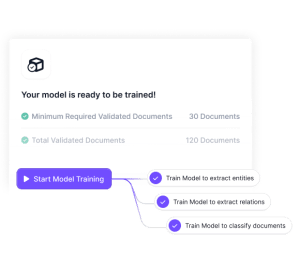
2. AI Model Flexibility
One of Kudra’s standout features is its flexibility in AI model selection and customization. This is crucial in financial report analysis, where different organizations may have unique reporting structures or specific data points of interest.
Choose from Pre-trained, Generative, or Custom Models
– Pre-trained Models: As mentioned earlier, these are ready-to-use models that cover a wide range of common financial documents. They’re an excellent starting point for most organizations.
.
– Generative Extractors: Based on advanced language models like GPT, these extractors can handle more complex, unstructured text. They’re particularly useful for extracting insights from management discussions, risk assessments, and other narrative sections of financial reports.
– Custom Models: For organizations with unique reporting structures or specific data extraction needs, Kudra offers the ability to create and train custom models. This ensures that the system can adapt to your specific requirements, no matter how niche they may be.
The ability to mix and match these model types within a single workflow is a game-changer. For instance, you could use a pre-trained model to extract standard financial metrics, a generative model to summarize management’s outlook, and a custom model to extract industry-specific KPIs – all within the same analysis pipeline.

3. Interpretation through Generative AI
Kudra’s capabilities extend far beyond mere data extraction. Its integration of generative AI technologies brings a new level of intelligence to financial report analysis.
Beyond Extraction: Insights and Summarization:
– Trend Analysis: By analyzing historical data across multiple reports, Kudra can identify and highlight trends in key financial metrics. This could include year-over-year growth rates, changes in profit margins, or shifts in debt-to-equity ratios.
.
– Anomaly Detection: The system can flag unusual patterns or discrepancies in the data, alerting analysts to potential areas of concern or interest. This could be particularly useful in identifying accounting irregularities or unexpected financial performance.
– Natural Language Summaries: Kudra can generate concise, human-readable summaries of complex financial data. These summaries can provide a quick overview of a company’s financial health, highlighting key strengths and potential risks.
– Comparative Analysis: When analyzing reports from multiple companies or across different time periods, Kudra can provide comparative insights, helping to contextualize performance within an industry or market.
The power of this feature lies in its ability to transform raw data into actionable insights. Instead of spending hours poring over numbers, analysts can start with a high-level overview and drill down into specific areas of interest.
4. Customizable Workflow Builder
Kudra’s visual workflow builder is a testament to its user-centric design philosophy. This feature allows users to create custom data extraction and analysis pipelines without the need for complex coding or technical expertise.
Visual Workflow Builder:
– Intuitive Interface : The drag-and-drop interface makes it easy to design complex workflows. Users can chain together different services – such as OCR, table extraction, form analysis, and generative AI interpretation – in a logical sequence.
– Conditional Logic: The workflow builder supports conditional logic, allowing for different processing paths based on the content or structure of the document. For instance, you could set up a workflow that applies different analysis models based on whether the document is a quarterly or annual report.
– Reusable Components: Common workflow elements can be saved as reusable components, streamlining the process of creating new workflows and ensuring consistency across different analysis tasks.
– Real-time Preview: As you build your workflow, Kudra provides real-time previews of the output at each stage. This allows for quick iteration and fine-tuning of the extraction and analysis process.
For financial analysts, this means the ability to create custom analysis pipelines tailored to specific reporting needs. Whether you’re focusing on liquidity ratios, profitability metrics, or complex industry-specific

Conclusion
In an era where data is both abundant and critical, the ability to efficiently and accurately analyze financial reports is indispensable. Kudra is transforming the landscape of financial data extraction and analysis, offering a solution that combines precision, speed, and ease of use. With its advanced AI capabilities, Kudra not only automates the tedious aspects of data extraction but also provides meaningful insights that drive informed decision-making. Whether you’re dealing with complex financial statements, regulatory filings, or narrative sections, Kudra’s flexible and powerful platform is designed to meet the diverse needs of financial analysts.
By leveraging Kudra, professionals in finance, accounting, and related fields can significantly reduce the time and effort required for financial report analysis, while improving accuracy and the depth of insights. This shift not only enhances productivity but also empowers analysts to focus on higher-value tasks, ultimately driving better business outcomes.