
We live in an age where data is king. From informing strategic decisions to optimizing operations, business success today depends on extracting value from data. However, many companies still struggle with efficiently collecting and making sense of the deluge of data available. Manual data processing simply cannot keep pace in a dynamic environment where insights need to be gleaned in real time.
This begs the question – how equipped is your business to tap into data’s true potential? Could automated data extraction be the competitive advantage you are missing out on?
This article will explore the must-have features of a robust data extraction tool that can unlock productivity and accelerate growth. We will also discuss Kudra, an award-winning AI platform purpose-built to transform document processing with precision and ease.
Understanding Data Extraction
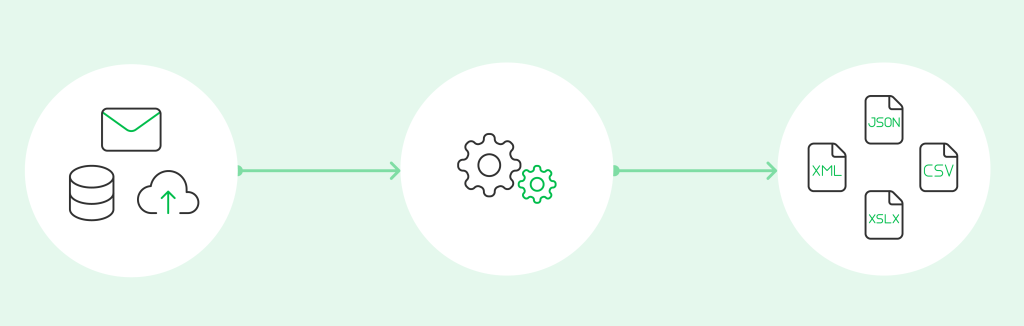
Data extraction refers to the process of automatically pulling structured information from documents and making it available for downstream analytics and workflows. Whether dealing with scanned PDFs, images, printouts, or even handwritten notes, an intelligent data extraction tool can identify and extract relevant text, tables, and other elements through Optical Character Recognition (OCR).
With accurate and consistent data extraction, disparate document-based data can be consolidated into structured databases. This data can then power everything from business intelligence dashboards to machine learning models.
However, most companies still rely on employees to manually gather and enter data – an approach that is slow, expensive, and prone to human error. Manual data processing also makes it impossible to scale analytics and meet the demands of fast-paced operations.
Intelligent automation technology can help overcome these challenges by extracting accurate data at scale, freeing up workforce capacity for strategic initiatives.
Key Features to Consider When Selecting a Data Extraction Tool
With the right document processing software, any organization can amplify productivity and insights by automating data capture. However, a data extraction tool doesn’t necessarily have the same features of another tool. The solution you choose should check the following boxes:
Evaluation Criteria for a Data Extraction Tool
I. Scalability and Performance
Your data extraction software must seamlessly scale to handle everything from a few documents to millions of pages, even fluctuating workloads. Industrial-grade OCR, machine learning, and infrastructure availability are key.
II. Security and Compliance
The tool must provide enterprise-grade security covering data encryption, access controls, and more to safeguard sensitive information. It should also comply with regulations like HIPAA and GDPR.
III. AI Capabilities
Intelligent document processing relies heavily on technologies like OCR, NLP, and computer vision. Evaluate the depth of native AI capabilities to handle unstructured data accurately.
IV. Data Source Compatibility
The solution should support ingestion from a wide variety of sources – PDFs, scanned images, emails, printouts, mobile captures, and even handwritten notes.
V. Data Quality Features
Mistakes are inevitable in AI. Your platform must provide confidence scoring, human-in-the-loop quality checks, and enable training custom AI models.
VI. Data Transformation and Integration Capabilities
To maximize value, the software should allow structuring extracted info and integrating it with business systems like RPA bots, databases, BI tools, etc.
VII. Automation and Scheduling
The tool must allow users to build automated workflows, set up notifications, and schedule recurring jobs through easy-to-use interfaces.
VIII. Reporting and Visualization
It should provide out-of-the-box analytics covering document processing metrics. Users should also be able to create custom reports and visualizations.
With criteria covering scalability, security, integration and more, you can zero in on extraction software capable of delivering true business impact. But even more important is the vendor’s industry expertise and commitment to customer success. Let’s look at how Kudra checks all the boxes.
The Kudra Advantage for Intelligent Data Extraction
Kudra is an award-winning AI software company providing an end-to-end document processing platform powered by industrial-grade machine learning. With capabilities tailored for business use cases, Kudra makes it easy to classify documents, extract data, and integrate it across systems.
I. Scalability and Performance
Purpose-built for the enterprise, Kudra can ingest millions of documents daily and extract data from them in near real-time. The distributed architecture ensures consistent SLAs even with fluctuating workloads.
II. Advanced AI Capabilities
Kudra utilizes cutting-edge AI techniques like transformers, OpenCV, and more to deliver over 99% data accuracy. Users can also train custom machine learning models when needed through an intuitive interface.
III. Broad Data Source Compatibility
Kudra supports structured and unstructured data ingestion from PDFs, scanned images, emails, mobile captures, and even handwritten notes while preserving original formats.
IV. Precision, Speed, and Ease of Use
At the core of Kudra’s platform is an ensemble of AI technologies that enable businesses to extract insights from documents with unparalleled precision, speed, and ease.
• Precise Data Parsing
Kudra can adeptly extract information from the most complex documents – from convoluted legal contracts to detailed logistics manifests – with near-perfect accuracy. This allows stakeholders to make decisions based on reliable data.

• Speed
By leveraging GPU-powered OCR, Kudra can parse millions of pages daily and deliver results in near real-time. This level of throughput allows businesses to achieve rapid ROI.
• Ease of Use
With an intuitive drag-and-drop interface, non-technical users can build automated workflows to ingest, process, and route documents without coding.

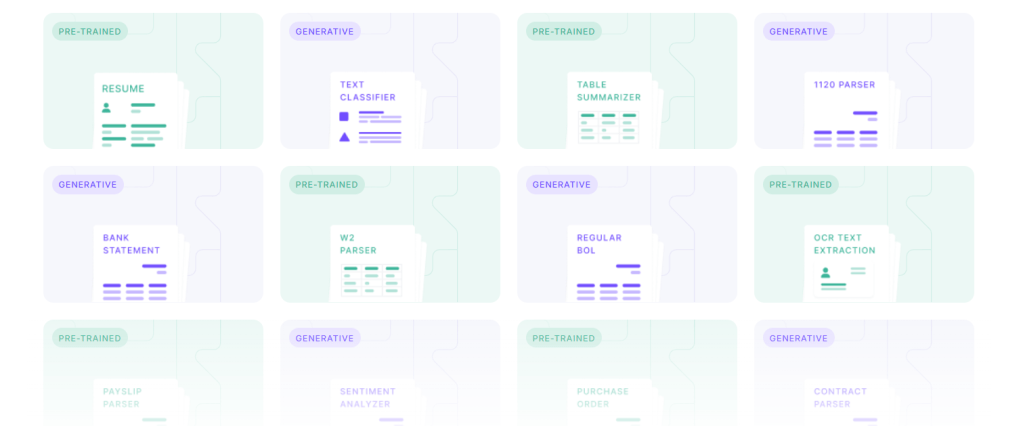
Kudra also provides 20+ pre-built AI apps and templates to accelerate adoption.
V. Seamless Integration
Kudra enables extracted data to be structured, stored, and synced across business systems in real-time via APIs and integrations. Destinations include databases, analytics tools, RPA platforms, and more.

VI. Automation and Scheduling
Users can schedule complex multi-step document analysis workflows or set up event-based triggers through Kudra. Real-time alerts keep stakeholders informed of job statuses.
In summary, Kudra drives tremendous efficiency by combining AI with an automation-first approach. Leading enterprises are already leveraging the platform to unlock 50-70% cost savings while accelerating insights.
Choosing the Best Data Extraction Tool for Your Business
For today’s digital businesses, adopting intelligent data capture tools is no longer optional – it is imperative to stay competitive.
When selecting your document processing software, be sure to evaluate the:
• Breadth of AI capabilities to drive accuracy
• Ability to handle complex unstructured documents at scale
• Data integration and automation features
• Overall vendor expertise and customer support
With out-of-the-box features tailored for business use cases, Kudra checks all these boxes and more. By combining industrial-grade AI with ease of use and actionable insights, Kudra accelerates ROI across industries.
Conclusion
In closing, adopting an enterprise-grade data extraction solution can prove transformational for modern businesses. With the influx of unstructured data showing no signs of slowing down, intelligent automation is key to harnessing its true potential while minimizing costs.
As highlighted throughout this article, Kudra is purpose-built to address document processing needs across industries with accuracy, speed, and ease. By leveraging Kudra’s AI platform, leading companies are already amplifying productivity and insights.
We encourage you to learn more about Kudra’s capabilities and request a personalized demo. See first-hand how intelligent data capture can help your business gain a competitive edge. The time for digital transformation through AI is now!


